 bizdif.com
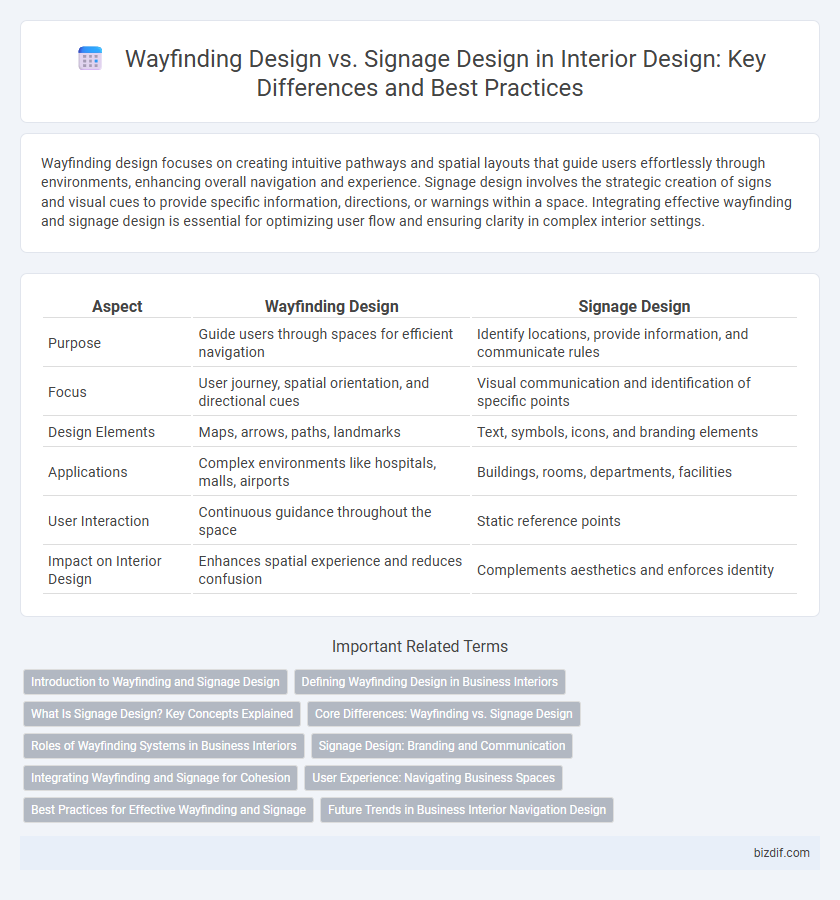
 Wayfinding design focuses on creating intuitive pathways and spatial layouts that guide users effortlessly through environments, enhancing overall navigation and experience. Signage design involves the strategic creation of signs and visual cues to provide specific information, directions, or warnings within a space. Integrating effective wayfinding and signage design is essential for optimizing user flow and ensuring clarity in complex interior settings.
Table of Comparison
| Aspect | Wayfinding Design | Signage Design |
|---|---|---|
| Purpose | Guide users through spaces for efficient navigation | Identify locations, provide information, and communicate rules |
| Focus | User journey, spatial orientation, and directional cues | Visual communication and identification of specific points |
| Design Elements | Maps, arrows, paths, landmarks | Text, symbols, icons, and branding elements |
| Applications | Complex environments like hospitals, malls, airports | Buildings, rooms, departments, facilities |
| User Interaction | Continuous guidance throughout the space | Static reference points |
| Impact on Interior Design | Enhances spatial experience and reduces confusion | Complements aesthetics and enforces identity |
Introduction to Wayfinding and Signage Design
Wayfinding design focuses on creating intuitive navigational systems that guide people through physical environments using visual cues, landmarks, and spatial logic. Signage design involves crafting clear, legible signs that communicate essential information, directions, and warnings to enhance user experience and safety. Both disciplines collaborate closely in interior design to improve spatial orientation and ensure seamless movement within complex structures such as hospitals, airports, and office buildings.
Defining Wayfinding Design in Business Interiors
Wayfinding design in business interiors involves creating intuitive navigation systems that help occupants easily locate key areas such as offices, meeting rooms, and amenities. It integrates spatial layout, visual cues, and environmental graphics to reduce confusion and enhance user experience. Effective wayfinding design improves operational flow and supports brand identity by guiding visitors and employees seamlessly through the space.
What Is Signage Design? Key Concepts Explained
Signage design involves creating visual graphics and symbols that effectively communicate information to guide people within a physical environment. It emphasizes clarity, legibility, and strategic placement to enhance user experience and ensure efficient navigation. Key concepts include message hierarchy, typographic choice, color contrast, and material durability to support functionality and aesthetic integration in interior spaces.
Core Differences: Wayfinding vs. Signage Design
Wayfinding design focuses on creating intuitive navigational systems that guide individuals through physical spaces by using spatial cues, landmarks, and environmental graphics. Signage design is primarily concerned with the creation and placement of signs that convey specific information or instructions within an environment. The core difference lies in wayfinding's holistic approach to spatial orientation versus signage's targeted communication of information.
Roles of Wayfinding Systems in Business Interiors
Wayfinding systems in business interiors play a crucial role in enhancing customer experience by guiding visitors efficiently through complex spaces, reducing confusion and improving accessibility. These systems integrate architectural elements, spatial layouts, and visual cues to create intuitive navigation paths, ultimately increasing operational efficiency and promoting brand identity. Unlike signage design, which primarily focuses on information display, wayfinding encompasses a broader strategic approach to spatial orientation and user journey optimization within commercial environments.
Signage Design: Branding and Communication
Signage design plays a crucial role in branding and communication by creating visual consistency that reinforces a company's identity throughout interior spaces. Effective signage combines typography, color, and iconography to guide visitors while enhancing brand recognition and conveying key messages clearly. This approach ensures that signs are not only functional for wayfinding but also act as strategic tools to strengthen customer engagement and loyalty.
Integrating Wayfinding and Signage for Cohesion
Integrating wayfinding design and signage design enhances spatial navigation by combining clear visual cues with strategic placement, ensuring users intuitively follow paths within complex environments. Cohesive wayfinding systems align typography, color schemes, and iconography across signage to create a unified brand experience and reduce cognitive load. This synergy improves accessibility, aids in emergency evacuation procedures, and elevates overall user satisfaction in interior spaces such as hospitals, airports, and corporate offices.
User Experience: Navigating Business Spaces
Wayfinding design enhances user experience by providing intuitive spatial orientation through clear visual cues and environmental graphics, helping individuals effortlessly navigate complex business spaces. Signage design complements this by delivering specific information via strategically placed signs that communicate directions, regulations, and services. Together, effective wayfinding and signage design reduce confusion, improve accessibility, and promote seamless movement within commercial environments.
Best Practices for Effective Wayfinding and Signage
Effective wayfinding design prioritizes intuitive layouts, clear visual hierarchy, and consistency in symbols to facilitate seamless navigation within spaces. Signage design must emphasize legibility through appropriate typography, contrast, and placement to enhance user comprehension and reduce confusion. Integrating wayfinding and signage best practices ensures efficient spatial orientation, supporting users in reaching destinations with minimal cognitive load.
Future Trends in Business Interior Navigation Design
Wayfinding design in business interiors prioritizes intuitive spatial navigation through integrated digital interfaces, while signage design relies on static visual cues like symbols and text. Future trends emphasize AI-driven adaptive wayfinding systems that respond to user behavior and real-time environmental changes, enhancing accessibility and efficiency. Smart signage incorporating AR technology will complement these systems by providing dynamic, context-sensitive information to improve user experience and operational flow.
Wayfinding Design vs Signage Design Infographic